Learn & Play
Learn 'n' Play
New to disc golf? You're in the right place. This page walks you through everything you need to start playing. The basics of the game, what gear to buy, and the handful of concepts (flight numbers, hyzer, stability) that turn a confusing bag of plastic into a set of tools you actually understand.
Getting Started
The rules, in one sentence
Throw a disc from the tee pad toward a metal basket, keep throwing from wherever it lands, and count your throws. Lowest total wins. That's the whole game.
An easy sport to pick up
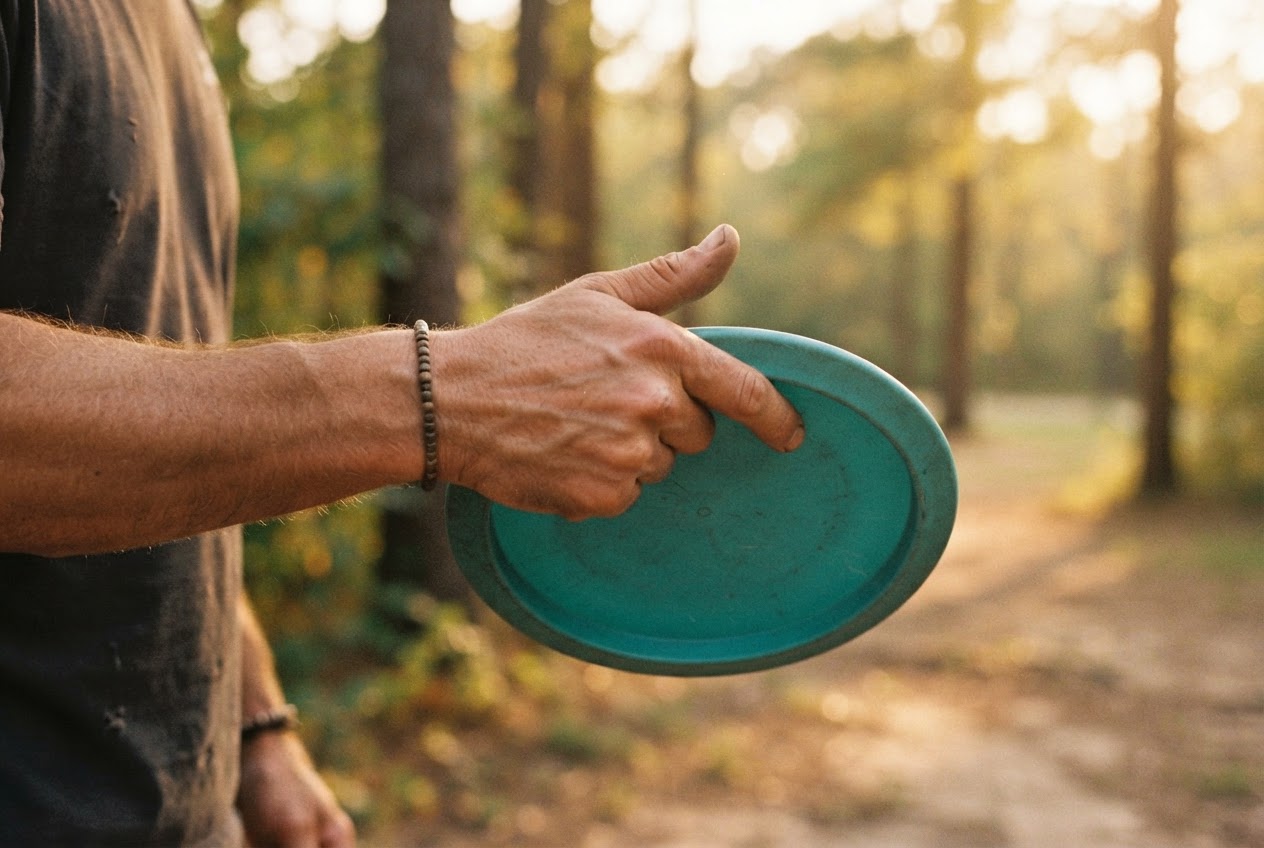
It's genuinely for all ages. Grandparents and eight-year-olds play the same courses on the same afternoon. There's no minimum arm speed, no contact, and no clock. Distance helps, but accuracy and smart decisions beat raw power more often than beginners expect, which is exactly why a first-timer can have a great hole against an experienced player.
It's cheap. Most disc golf courses are in public parks, and a large number of them are completely free to play. Where there is a fee, it's usually a few dollars or a small seasonal pass. Compare that to a round of ball golf and the difference is dramatic.
No dress code and no tee times. Show up in whatever you're comfortable walking a few kilometres in. Most courses are first-come, first-served. You just walk to hole 1, wait for the group ahead to clear, and go. Weekday mornings and evenings are usually wide open.
You only need one disc. Seriously. A single putter or midrange is enough to play a full round, and it's one of the fastest ways to actually get better. When you have one disc for every shot, you're forced to learn how to change its flight with your angle, your power, and your release point instead of reaching for a different piece of plastic. Players who spend a season throwing "one-disc rounds" almost always come out with better form and a much better feel for shot shaping.
The basic rules
You don't need the full rulebook on day one. These cover 95% of what comes up:
- Tee off with at least one foot on the tee pad. Throw toward the basket.
- Play from where it lands. Walk to your disc, place a marker (or use the disc itself) at the front edge of where it came to rest, and make your next throw with your supporting foot behind that point.
- Furthest from the basket throws first. On the tee, whoever scored best on the previous hole throws first.
- The hole is complete when your disc comes to rest in the basket — supported by the chains or resting in the tray. Discs that hit the top of the basket or bounce out don't count; keep playing.
- Out of bounds (OB) costs you one stroke, and you play your next shot from within one metre of where the disc last crossed the OB line. Courses mark OB with paint, signs, or natural features like a creek or road.
- Mandatories ("mandos") are marked arrows that your disc must pass on the correct side, usually for safety. Miss it and you take a penalty and throw from the drop zone.
- Inside the Circle (10 metres / 33 feet): on a putt from inside this range, you must show balance and can't step past your marker toward the basket until the disc has come to rest. Outside the circle, you're free to follow through and walk forward.
- Be safe and be patient. Never throw when someone is downrange, and let faster groups play through.
Scoring terms
Every hole has a par — the number of throws a solid player is expected to need. Most holes are par 3.
| Term | Meaning |
|---|---|
| Ace | A hole-in-one. The moment everyone in disc golf is chasing. |
| Albatross (double eagle) | Three throws under par |
| Eagle | Two throws under par |
| Birdie | One throw under par |
| Par | Even — exactly the expected number |
| Bogey | One throw over par |
| Double bogey | Two throws over par |
| Triple bogey | Three throws over par |
Scores are most often written relative to par, not as a raw total. A round of "-2" means you finished two throws under the course's par.
Finding courses and track your rounds
UDisc is the most common way to find information about your local courses and track your rounds. This is not an ad spot or a sponsor, we just enjoy the app.
- Find courses near you with maps, photos, hole-by-hole layouts, difficulty ratings, and reviews from local players
- Keep score for your whole group, so nobody has to remember what everyone shot on hole 7
- Track your progress over time — see your average score per course, your best rounds, and where you're actually losing strokes
- Navigate the course with GPS distances and hole maps, which is a lifesaver the first time you play somewhere new
The free version covers scoring and course finding. The Pro version adds deeper stats and offline maps. Either way, install it before your first round.
Course etiquette
Disc golf runs almost entirely on good manners rather than officials, and the etiquette is genuinely simple. Get these right and you'll be welcome anywhere.
Safety first
- Don't throw when anyone is downrange. Disc golf discs are heavier and faster than they look, and they hurt.
- Yell "FORE!" loudly if your disc is heading anywhere near a person. Disc golf borrowed the word from ball golf and it's universally understood. Yell it early and yell it loud — being embarrassed is much better than the alternative.
- Watch out for the public. Most courses share space with parks, trails, and playgrounds. People who aren't playing will be sharing the park with you, and you should yield to them, always.
Respect the group
- Stay quiet and still while someone is throwing. No talking, no walking through their line of sight, no rattling your bag.
- Stand behind the person throwing, never beside or in front of them.
- Let faster groups play through. If a group behind you is waiting on every hole, wave them past at the next tee. It costs you two minutes and it's the single most appreciated thing you can do as a new player.
- Help look for lost discs. Everyone in the group hunts. It's how you make friends. If you find a lost disc
- Keep pace. Have your disc ready when it's your turn, and don't take five practice throws before every shot.
Respect the course
- Pack out everything you bring in. Cans, wrappers, all of it.
- Don't break branches or move obstacles to open up your line. The tree is part of the hole.
- Stay off wet, soft ground where you'd tear up the turf, and respect any posted closures.
Your first five rounds
- Write your name and phone number on every disc. Disc golfers are honest people and lost discs get returned constantly, but only if there's a way to reach you. Use a permanent marker on the underside of the flight plate.
- Bring water. More than you think. A round is a 3-6 km walk.
- Wear comfortable shoes With decent grip. Trail runners or any athletic shoe with tread. Skip the sandals.
- Expect to lose a disc. It happens to everyone, it's not a sign of failure, and it's a great excuse to buy another one. Bright colours help, avoid green, brown, and clear plastic if you can.
- Tell someone where you're going If you're playing alone, especially on wooded or remote courses.
- Bring a small towel. Wet or muddy hands are the fastest way to a bad throw.
- Go early or late on your first outing. Quieter course, less pressure, more time to figure things out.
- Only keep score if you want to. There's no pressure to keep score, you can just walk around and throw while you learn.
Putting to win
Here's the thing nobody tells beginners: you'll lose far more strokes inside 10 metres than you'll ever gain by throwing further off the tee. Putting is the cheapest, fastest way to improve, and you can practise it in your backyard, your garage, or your living room. You don't even need an official target, just use a tree or stake in the ground.
The basics
- Get a stance you can repeat. When putting, most players either stagger (throwing-side foot forward, weight shifting toward the basket) or straddle (feet level and shoulder-width, body facing the basket). Straddle is very beginner-friendly and helps around obstacles. Try both and keep the one that feels natural.
- Aim at the chains, not the basket. Pick a specific link. Vague targets produce vague putts.
- Push, don't throw. A putt is a smooth, controlled extension toward the target — not a small drive. Let your legs and core provide the power so your arm can stay relaxed.
- Follow through toward the target and hold your finish until the disc lands. If you're falling sideways, your line will go sideways too.
How to practise
Get a few identical putters and putt from the same distance until you're consistently making them, then move back. Ten minutes a day beats two hours once a month. Start at 3 metres, not 10. Building confidence matters more than building range.
The fastest way to improve
Throwing on the course teaches you to score. Throwing in an open field teaches you to throw.
Grab 3–5 discs, find an empty park or sports field, and throw them all in the same direction, then walk down and throw them back. No trees, no score, no pressure, no walking between every shot. You'll get more meaningful repetitions in 30 minutes than in three full rounds.
This is a great way to learn how different discs fly. Throw a few different discs with the same throw at the same target and see the differences.
What to work on:
- One thing at a time. Pick a single focus. Nose angle, footwork, a smooth pull — and stay on it for the whole session.
- Throw flat and straight before anything else. Distance is a byproduct of good form, not a goal you chase directly.
- Slow down. Throwing at 70% with good technique will out-distance throwing at 100% with bad technique, nearly every time.
- Film yourself. A phone propped against your bag is the best coach a new player can get for free. What you feel and what you're actually doing are rarely the same thing.
- Watch your landing, not your release. Where the disc finishes tells you what your angle and nose position actually were.
What to Buy
Here's the honest version: you can start with about the price of a couple of coffees, and you don't need a driver yet.
Option 1: A single disc
If you buy one thing, buy a putter or a midrange.
These are the slowest, easiest discs to throw, and that's exactly why they're the best teachers. Because they don't require high arm speed to fly the way they're designed to, they'll go relatively straight for a brand-new player. High-speed drivers do the opposite, thrown without the power they were built for, they veer hard to the left (for a right-handed backhand throw) and dive into the ground, which feels like the disc is broken and you're doing everything wrong.
A putter or midrange gives you honest feedback. If it goes left, that's your angle or your form telling you something — not the disc.
Additionally, for slower arm speeds a putter or midrange will fly almost the same distance as a driver, so you don't even lose distance by going with a "slower" disc.
Start here if: you want the cheapest possible entry, you're playing with someone who can lend you a disc or two, or you want to commit to learning proper form.
Option 2: A 3-disc starter pack
The most popular starting point, and for good reason. A starter set gives you one putter, one midrange, and one driver. The three tools that cover every shot on a course.
- Putter — short approach shots and putting into the basket
- Midrange — mid-length shots, controlled and accurate
- Driver — your longest throws off the tee
Starter packs are built specifically for new players: lighter weights, beginner-friendly stability, and a price that's a fraction of buying the three discs separately. They also save you from the classic beginner mistake of buying a high-speed distance driver as your first disc.
Start here if: you want everything you need in one purchase and plan to play more than a handful of rounds.
Add a small bag
Once you have more than two or three discs, carrying them in your arms gets old fast.
A small bag that holds 3–8 discs plus a water bottle is all most players need for a long time. Look for:
- A comfortable shoulder strap (you're walking a few kilometres)
- A dedicated water bottle pocket, you'll use it every round
- A small zip pocket for items such as keys, a wallet, or your phone
Skip the giant tournament backpack for now. It's more bag than a new player needs, and a light bag makes the walk more enjoyable.
What you don't need yet
- A high-speed distance driver (10 speed and up)
- More than 3 discs
- A cart
- Specialty shoes
All of that comes later, if at all. Get out and play first.
Flight Numbers
Almost every disc has four numbers printed on it, and once they click, shopping for discs stops being guesswork.
They always appear in the same order:
Speed · Glide · Turn · Fade
Example: 5 | 5 | -1 | 1
Think of them as a description of the disc's flight from start to finish.
Speed (1–14)
How fast you need to throw the disc for it to fly the way it was designed to. This is not how far the disc will go.
Low-speed discs (putters at 1–3, midranges at 4–5) fly properly at speeds a brand-new player can already produce. High-speed drivers (10–14) need serious arm speed, and without it they simply never do what the other numbers promise.
Higher speed does not mean more distance for you. For most new players, a speed 6 fairway driver will out-distance a speed 13 distance driver, because the slower disc actually gets to fly as intended.
Glide (1–7)
How well the disc stays in the air as it slows down. Higher glide means the disc floats further with less effort.
More glide is generally your friend as a beginner, as it's free distance. The trade-off is that high-glide discs are harder to control in wind and harder to stop where you want them on tight, wooded holes.
Turn (+1 to -5)
Turn describes what the disc does early, while it's still moving fast and flying flat out of your hand.
- A more negative number (-3, -4) means the disc will bank to the right early in flight (right-hand backhand). These discs are easier to get flying for players who are still building arm speed.
- A number near 0 or +1 means the disc resists that early turn and holds its line or fights back.
Fade (0–5)
Fade describes what the disc does at the end of the flight, as it slows down and drops.
- A low fade (0–1) means the disc finishes gently, close to straight, with a soft landing.
- A high fade (3–5) means the disc hooks hard to the left at the end (right-hand backhand) and drops sharply.
The easiest way to remember
Turn is the beginning of the flight. Fade is the end of the flight.
Read the numbers left to right and you're literally reading the flight in order: How hard do I need to throw it (speed) → how long does it stay up (glide) → what does it do early (turn) → what does it do at the end (fade)?
A 5 | 5 | -1 | 1 midrange: throw it flat, it drifts slightly right early, floats along, then fades gently back left as it lands. That's a beautiful, nearly straight "S" that finishes soft. Exactly what a new player wants.
Important: flight numbers assume a right-handed backhand throw
Every flight number you'll ever read is written for RHBH — right hand, backhand. That's the industry standard.
Here's how it translates:
| Throwing style | Flight |
|---|---|
| RHBH (right hand, backhand) | As printed — turn goes right, fade goes left |
| LHFH (left hand, forehand / flick) | Same as printed — turn right, fade left |
| LHBH (left hand, backhand) | Mirrored — turn goes left, fade goes right |
| RHFH (right hand, forehand / flick) | Mirrored — turn goes left, fade goes right |
So RHBH and LHFH behave identically, and LHBH and RHFH behave identically — just flipped. If you're a lefty backhand thrower, read every number on this page and every disc description online as the mirror image.
What to look for as a beginner
Look for low speed, high glide, negative turn, and low fade.
- Speed 1–5 (putter or midrange), or up to speed 6–7 for a first fairway driver. These fly correctly at the arm speed you have right now.
- Glide 4–6. More float, more distance, less effort.
- Turn -1 to -3. The disc wants to hold a straight line instead of immediately hooking left. This is the number that makes a disc feel "easy."
- Fade 0–2. A gentle finish instead of a hard dive into the ground.
- Lighter weight, roughly 150–165g, is easier to get up to speed and easier on your arm and shoulder while you're learning.
A good beginner disc is one that rewards a smooth throw instead of punishing a slow one.
Hyzer and Anhyzer
Flight numbers describe what a disc does on its own. Hyzer and anhyzer describe what you tell it to do. Together, they're how you shape shots.
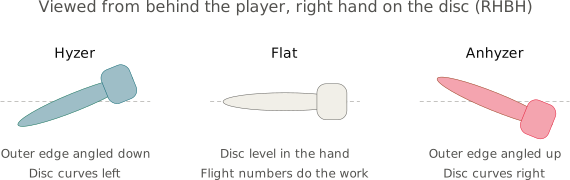
Both words simply describe the angle of the disc when it leaves your hand.
Hyzer
The outside edge of the disc is tilted downward — for a right-handed backhand thrower, that means the disc's left edge is lower than the right.
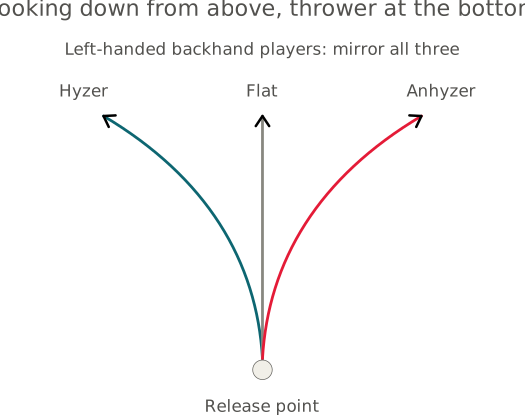
A hyzer release makes the disc curve left (RHBH) throughout its flight and finish left. It's the most stable, most predictable, most repeatable release in the sport, and it's the shot you want when you need to get around an obstacle on your left or you absolutely cannot afford to have the disc go right.
Anhyzer
The outside edge is tilted upward — the left edge is higher than the right (RHBH).
An anhyzer release makes the disc curve right and finish right. It's how you get around an obstacle on your right, and how you make a disc fly further right than its flight numbers alone would suggest.
Flat
The disc is level at release. This is your baseline, straight-line shot and the release that lets the disc's own flight numbers do the talking.
Lefty note: flip all of the above. A LHBH hyzer curves right, and an anhyzer curves left.
Knowing these terms
Three reasons why you need to know these terms:
- It's the vocabulary of the sport. Every video, every course description, every tip you get from a player at your local course uses these two words constantly.
- It's how you get around trees. Courses are designed with obstacles. Hyzer and anhyzer are the two tools that let you throw around them instead of into them.
- It's how one disc becomes ten discs. Change the angle and you change the flight — no new plastic required.
Shot shaping
For shaping your throw, angle + stability = everything. Once you combine release angle with disc stability, a small bag covers an enormous range of shots. These are the shapes you'll hear named (all RHBH):
- Hyzer — Overstable disc, hyzer release. Curves left the whole way and finishes hard left. Reliable in wind.
- Anhyzer — Stable or understable disc, anhyzer release. Curves right and finishes right.
- Hyzer flip — Understable disc thrown on hyzer with enough power that it flips to flat and flies dead straight, holding that line to the ground. The straightest shot in disc golf.
- Flex shot (hyzer flip to fade / "S" shot) — Understable disc thrown on a slight hyzer. The disc flips up to flat, holds right for a while, then fades back left at the end. Maximum distance, gorgeous to watch.
- Turnover — Understable disc thrown flat or on slight anhyzer that turns right and stays right.
- Flat / straight — Stable disc, flat release. It goes where you're pointing.
- Spike hyzer — Overstable disc thrown on a steep hyzer angle. Climbs, then drops almost vertically. Perfect for landing behind an obstacle or stopping fast on a tight green.
- Roller — Thrown at a sharp anhyzer angle so the disc lands on its edge and rolls. Situational, but it covers huge ground on open holes.
Don't try to learn all of these at once. Get comfortable with a flat throw and a hyzer first — those two will get you around any course.
Stability
Stability is a single word describing a disc's natural tendency to resist or give in to turning right (RHBH) while it's flying. It's determined by the turn and fade numbers together, and it's the single most useful concept for choosing discs.
Understable (a.k.a. "flippy")
Typical numbers: turn -3 to -5, fade 0 to 1
These discs want to turn right and stay there. They're the easiest for new players to throw far, because they don't fight your lower arm speed, they fly the way they're designed to fly without needing power to keep them from hooking left.
Use them for: turnovers, hyzer flips, long straight shots, right-curving lines, and generally maximizing distance while you're still building form.
Watch out for: headwind. Wind makes an understable disc turn over even harder, and it can roll away on you.
Stable / Neutral
Typical numbers: turn 0 to -1, fade 1 to 2
The middle ground. Thrown flat with good form, these discs fly essentially straight with a gentle finish. They do exactly what you point them at.
Use them for: straight lines, controlled approaches, and anything where you want predictability. Most great midranges live here.
Overstable
Typical numbers: turn 0 to +1, fade 3 to 5
These discs resist turning right no matter what, and they finish hard left. They're the most predictable discs in the sport, but they're not beginner-friendly: without high arm speed they'll simply dive left almost immediately.
Use them for: windy conditions, spike hyzers, forehand approaches, and any shot where you need the disc to reliably hook left and stop.
A note for new players: overstable discs are not "better" or "more advanced" discs. They're specialty tools. Buying an overstable driver as your first disc is the most common reason people conclude they're bad at disc golf and quit.
How to judge stability by feel, without knowing the numbers
You'll eventually run into discs with worn-off stamps, blank plastic, or a used-bin find. Here's how to read a disc with your hands and eyes.
Hold the disc edge-on at eye level and look at its profile. Find the nose — the widest, outermost point of the rim, the part that cuts through the air first.
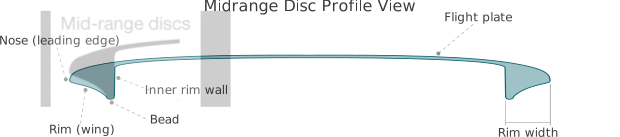
- More of the disc's profile sits ABOVE the nose — a rounded, domey top with the leading edge angled slightly upward. This shape tends toward understable. Domey discs generally want to turn.
- More of the disc's profile sits AT or BELOW the nose — a flat top with a blunt, squared-off or downward-tapering leading edge. This shape tends toward overstable. The blunt nose grabs air and forces the disc to fade.
Other things you can feel:
- Rim width. A wide rim means a high-speed disc that needs power. A narrow rim is slower and more beginner-friendly.
- Dome vs. flat. Press your palm on the flight plate. A pronounced dome usually means more glide and more turn. A flat top usually means more fade and better wind resistance.
- Weight. Heavier discs in the same mold fly more overstable. Lighter discs in the same mold fly more understable.
- Wear. Every disc becomes more understable as it gets beat up. A tree-scarred, dinged-up disc will turn more than the same disc fresh out of the box, which is why experienced players deliberately hang on to their "beat-in" favourites.
These are tendencies, not laws. Rim configuration matters more than any of them. But if you're standing over a mystery disc, the profile test will steer you right the large majority of the time.
What to look for as a beginner
Choose understable to neutral. Choose light. Choose slow.
The reason comes down to one thing: arm speed. A disc's rated stability assumes it's being thrown at its rated speed. Throw a disc slower than it wants to go, and it behaves as if it's more overstable than the numbers say. That's why a speed 12 overstable driver in a new player's hand doesn't fly 400 feet — it flies 150 feet and hooks straight into the ground on the left.
Pick a disc that's understable at your speed, and it will fly straight and far. As your arm speed grows over the next season, that same disc will start turning over more — and that's your signal to move up to something more stable. Your bag should grow with you, not ahead of you.
Disc Weight
Every disc has its weight stamped or written on it, in grams. The legal maximum is 176g, and discs run all the way down to around 130g and lighter.
Weight is the quietest of all the disc variables, and it changes more than most new players realize.
What weight actually does
Lighter discs (roughly 150–165g)
- Easier to get up to speed, so they fly closer to their rated flight at lower arm speeds
- Fly more understable than the exact same mold in a heavier weight
- Travel further for players who are still building power
- Easier on your shoulder, elbow, and wrist
- More affected by wind, and more likely to get pushed off line
Heavier discs (roughly 170–176g)
- Require more arm speed to reach their rated flight
- Fly more overstable than the same mold in a lighter weight
- Cut through wind far better and hold their line in a headwind
- More predictable and consistent once you have the power to throw them
- Land with more authority and skip less unpredictably
The key point: the same mold in two different weights is effectively two different discs. A 150g version of a driver and a 175g version of that same driver will not fly the same way for you.
What to look for as a beginner
Aim for 150–165g for drivers and midranges.
That range is the sweet spot for developing players. It's light enough that you can get the disc moving fast enough to actually fly, without being so light that a light breeze takes it into the woods.
Putters are the exception — go heavier. Most players putt best with a putter in the 170–175g range. A heavier putter is more stable in the air, less affected by wind, and less likely to skip away from the basket when you miss. It also gives you better feel on short approach shots.
A note on age and physical ability: juniors, seniors, and anyone dealing with a shoulder or elbow issue often do much better in the 145–160g range across the whole bag. Lighter plastic is easier on the joints and does not mean you're playing an easier version of the game.
As you improve
Once your arm speed comes up, you'll notice your light discs starting to turn over more than you want. That's not the disc going bad — that's you getting better. It's the natural signal to start adding heavier weights and more stable molds to your bag. Most players end up with a mix: lighter discs for max-distance shots and heavier ones for wind and control.
Plastic Types
The same disc mold is usually sold in several different plastic blends, and the plastic changes the grip, the durability, the price, and how the disc's flight changes over time. Every manufacturer uses their own names for their blends, but they all fall into a few broad categories.
Base plastic
Common names include Innova DX, Discraft Pro-D, Dynamic Discs Prime, Latitude 64 Zero, MVP Electron, Discmania D-Line, and others.
- Cheapest — often less than half the price of premium
- Grippiest, especially in cold or wet conditions
- Softer and less durable — trees and pavement leave real marks
- Beats in fast, meaning the disc becomes more understable over a season of use
Great for: putters (the extra grip is a real advantage), your first few discs, courses full of trees where discs take a beating, and anyone who doesn't want to lose an expensive disc in a pond on hole 4.
Premium plastic
Common names include Innova Champion and Star, Discraft Z and ESP, Dynamic Discs Lucid and Fuzion, Latitude 64 Opto and Gold, MVP Neutron and Proton, Discmania C-Line and S-Line, and many more.
- Much more durable — a premium disc can hold roughly its original flight for years
- Holds its stability, so the disc you learn stays the disc you know
- More expensive
- Slicker in the hand for some blends, though the grippier premium lines (Star, ESP, Fuzion, Gold) solve this
- Often available in translucent or shiny colours, which look fantastic and can be harder to find in tall grass
Great for: discs you rely on, overstable discs you need to stay overstable, and anything you plan to keep for a long time.
Special-purpose blends
- Soft / gummy plastics are used mostly for putters. They grip the chains and drop straight down instead of bouncing out.
- Glow plastics contain phosphorescent material for night rounds. Charge them with a flashlight before you throw.
- Cold-weather blends stay flexible below freezing instead of turning brittle. Worth knowing about if you play through winter.
- Blended and overmold plastics combine two materials — often a grippier flight plate with a firmer rim — for a specific balance of feel and durability.
What to look for as a beginner
A mix, honestly, and here's the reasoning:
- Base plastic for putters and midranges. The grip genuinely helps, it's cheap, and beating in a midrange over a season gives you a lovely straight-flying disc you'll keep forever.
- Premium plastic for drivers, if the budget allows. Drivers hit more trees and travel further into rough ground, and you want that flight to stay consistent while you're learning what it does.
- Don't pay a premium for a disc you're likely to lose. Water holes and thick woods are base-plastic territory.
One more thing worth knowing: a beat-in base plastic disc is not a worn-out disc. Many experienced players have a favourite scarred-up mid that they'd never replace, precisely because years of use turned it into something the factory can't sell.
Tournaments
Casual rounds are the heart of disc golf, but tournaments are where the community really opens up — and they're far more welcoming to beginners than most people expect. There are divisions specifically for new and recreational players, and you'll be competing against people at your own level, not touring pros.
Local club membership
Most areas have a local disc golf club or association that runs weekly leagues, monthly events, and course maintenance days. Many of their events require or discount for club membership, and dues are usually modest, often less than the cost of a couple of discs for a full year.
Beyond tournament access, a club membership is the fastest way to meet local players, learn the courses, and find out which nearby course you've been driving past for years without knowing.
In Edmonton: the Edmonton Disc Golf Association (EDGA) is the volunteer-run club behind most of the events, leagues, and course development in Edmonton and the surrounding communities. Their site is the best place to find current membership info, league nights, and which local courses are worth your first visit.
In Calgary: the Calgary Disc Golf Club (CDGC) is also a volunteer-run club behind most of the events, leagues, and course development in Calgary and the surrounding communities. Their site is the best place to find current membership info, league nights, and which local courses are worth your first visit.
Canadian players: how the organizations fit together
If you're playing in Canada, there are a few layers, and it's less complicated than it looks:
- Your local club — EDGA in Edmonton, CDGC in Calgary, or the equivalent club wherever you play. This is the one that actually affects your week-to-week disc golf. Weekly leagues, doubles nights, local tournaments, course work days.
- Your provincial body — the Alberta Disc Golf Association coordinates between Alberta clubs and runs the provincial tour and championships. Similar organizations exist in most provinces.
- CanDiscGolf (Canadian Disc Golf Association) — the National Sport Organization for disc golf in Canada. They handle national-level sanctioning, development, and the Canadian National Championships, and they represent the provincial organizations.
- PDGA Canada — the PDGA's Canadian branch office. Entry fees and non-member fees collected at Canadian events flow through here and get reinvested into Canadian disc golf.
- PDGA — the international governing body, covered below.
For a new player, the practical version is: join your local club, and add a PDGA membership once you start entering sanctioned events. That's it.
PDGA membership
The Professional Disc Golf Association (PDGA) is the sport's international governing body, and despite the "professional" in the name, anyone can join. Amateur, junior, and professional membership levels are all available for a yearly fee — check pdga.com/membership for current pricing in your region.
A PDGA membership gets you:
- A permanent lifetime PDGA number and a player profile
- A player rating that updates as you compete, so you always know which division you belong in
- Reduced entry fees members pay less than non-members at PDGA-sanctioned events in the US and Canada, so it can pay for itself in a handful of tournaments
- Tracked stats and lifetime event history
- Partner discounts, including on UDisc Pro
You do not need a PDGA membership to play casually, or to play most local unsanctioned events. You'll want one once you start entering sanctioned tournaments regularly. Note that many events let you play as a non-member by paying a small temporary membership fee at registration, which is a good way to try a tournament before committing.
Memberships run on the calendar year. Join or renew after October 1 and you're covered through the end of the following year, which is a nice bit of free time if you're signing up in the fall.
Where to find tournaments
- PDGA Event Search — every sanctioned tournament worldwide, searchable by location, date, and tier. The upcoming events map is the fastest way to see what's happening near you.
- Disc Golf Scene — the go-to site for both sanctioned and unsanctioned events, including local leagues, doubles nights, and casual tournaments that never touch the PDGA calendar.
- UDisc — event listings alongside its course directory.
- Your local club's website and social media — weekly leagues and one-off events often get announced here first and nowhere else.
- Ask at your local course. Disc golfers are famously happy to tell a new player where and when to show up.
What to expect as a beginner
Show up early, bring water and snacks, and don't stress about your score. You'll be grouped with players in your division, someone in the group will keep score, and if you're unsure about a rule, just ask. Nobody expects a new player to have the rulebook memorized. Most first-timers find the whole thing far more relaxed than they'd imagined.
Playing in the Winter
Disc golf doesn't have an off-season, it has a different season. Winter rounds are quiet, the courses are empty, the sightlines open up once the leaves are gone, and there's something genuinely great about being the only group out there. Plenty of players say winter is their favourite time to play.
It does take a bit of preparation.
Don't lose your discs in the snow
This is the number one winter problem, and it's completely solvable.
- Bright colours only. Orange, pink, yellow, and red. White discs are invisible in snow, and so are blue ones once the light goes flat on an overcast day.
- Tie ribbon or bright flagging tape to your discs. A short strip taped to the flight plate costs almost nothing and makes a buried disc findable. It affects the flight slightly, which is a trade most players are happy to make.
- Watch your disc all the way down and pick a landmark. Snow erases footprints and everything looks the same fifty metres later.
- Throw lower and flatter. A disc that skids across the surface is findable. A disc that drops in nose-first from a high hyzer will vanish, sometimes until spring.
- Consider leaving your favourites at home on deep-snow days.
Plastic in the cold
Cold plastic behaves differently, and this catches people out.
- Base plastic gets brittle below freezing and can crack or chip on a hard tree hit. Premium and cold-weather blends stay more flexible.
- Grip is the real problem. Everything gets slick, and cold hands lose fine motor control fast.
- Discs fly slightly shorter in cold air. Denser air means more drag. Expect to lose some distance and don't fight it.
- Discs also fly slightly more overstable in cold, dense air. Something a touch more understable than usual can be a good call.
Staying comfortable
- Layer. You'll warm up dramatically once you're walking. Something you can unzip beats something you have to take off.
- A thin glove on your non-throwing hand keeps you warm without affecting your grip. Some players use a glove on the throwing hand too and take it off to throw.
- Hand warmers in your pocket or bag are transformative. Slip your throwing hand in between shots.
- Warm up slowly and thoroughly. Cold muscles are how shoulders and elbows get injured. Take extra time before your first real throw, and expect to throw at less than full power for the first few holes.
- Traction matters. Icy tee pads are genuinely dangerous. Consider slip-on cleats or ice grips, and don't take a full run-up on a pad you don't trust — a standstill throw is fine.
- Bring a thermos. Not strictly necessary. Highly recommended.
Course conditions
Check whether your local courses stay open through winter and whether the baskets stay in — some clubs pull them, and some parks limit access. Snow changes hole distances and lines considerably, and a hole you know well in July can play completely differently in January. UDisc course pages and your local club's social media are the best sources for what's currently open and playable.
Glossary
Ace — A hole-in-one.
Albatross — Three throws under par on a hole. Also called a double eagle.
Anhyzer — A release angle with the outside edge of the disc tilted upward, curving the flight right (RHBH).
Approach — A shot intended to land close to the basket, usually from short or mid range.
Backhand — The most common throwing style, where the disc is pulled across the body, similar to a frisbee throw.
Bag — What you carry your discs in. Also used as a verb: "I bag that disc."
Basket — The target. Officially a Disc Pole Hole: a pole, hanging chains, and a metal tray.
Beat in — A disc that has been worn down through use and flies more understable than it did new. Usually a compliment.
Birdie — One throw under par on a hole.
Bogey — One throw over par. Double bogey is two over, triple bogey is three over.
Chains — The hanging metal chains on the basket that catch the disc.
Circle 1 (C1) — The area within 10 metres (33 feet) of the basket, where the putting rules apply.
Circle 2 (C2) — The area between 10 and 20 metres (33–66 feet) from the basket.
Disc golf — The sport. Not "frisbee golf," though everyone will know what you mean.
Distance driver — The highest-speed discs (speed 10–14), designed for maximum distance and high arm speed.
Dome — The upward curvature of a disc's top surface. Domey discs generally glide more and turn more.
Drive — Your first throw on a hole, from the tee pad.
Drop zone — A marked area where you throw from after a penalty, such as missing a mandatory.
Eagle — Two throws under par on a hole.
Fade — The disc's tendency to hook left (RHBH) at the end of its flight as it slows down. The fourth flight number.
Fairway driver — Mid-speed drivers (speed 6–9). More controllable than distance drivers and a great step up for improving players.
Flex shot — An overstable or stable disc thrown on an anhyzer angle so it flexes back to the left at the end.
Flight numbers — The four-number rating (speed, glide, turn, fade) describing how a disc flies.
Flight plate — The flat top surface of the disc.
Flip up — When an understable disc thrown on hyzer rises to a flat angle during flight.
Forehand (flick / sidearm) — A throwing style where the disc is thrown from the same side as the throwing arm, palm up.
Glide — A disc's ability to stay aloft. The second flight number.
Grip lock — Holding onto the disc a fraction too long, sending it hard right (RHBH). Every player's least favourite moment.
Hyzer — A release angle with the outside edge of the disc tilted downward, curving the flight left (RHBH).
Hyzer flip — An understable disc thrown on hyzer with enough power that it flips to flat and flies straight.
Lie — The spot where your disc came to rest, and where your next throw is made from.
LHBH / LHFH / RHBH / RHFH — Left- or right-hand, backhand or forehand. Used to describe which way a disc will curve.
Mandatory (mando) — A marked obstacle your disc must pass on a specified side.
Midrange — Medium-speed discs (speed 4–5) known for accuracy and control. The most versatile discs in the bag.
Mini — A small marker disc used to mark your lie.
Nose — The leading outer edge of the disc.
Nose up / nose down — The angle of the disc's leading edge at release. Nose up kills distance; nose down carries further.
OB (out of bounds) — Areas marked as off-limits. Costs one penalty stroke.
Overstable — A disc that resists turning right and fades hard left (RHBH). Predictable and wind-resistant.
Par — The expected number of throws for a hole.
PDGA — Professional Disc Golf Association, the sport's international governing body.
Plastic — Slang for discs generally, and also for the specific material blend a disc is made from, which affects grip and durability.
Pull — The motion of drawing the disc across your body during a backhand throw.
Putt / putting — The final throw or throws into the basket, usually from inside Circle 1.
Putter — The slowest, most controllable discs (speed 1–3), used for putting and short approaches.
Roller — A shot deliberately thrown so the disc lands on its edge and rolls along the ground.
Run-up — The approach steps taken before a drive to generate power.
Scramble — Recovering to make par (or better) after a bad shot.
Spike hyzer — A steep hyzer that drops almost vertically, used to stop the disc quickly.
Stability — A disc's overall tendency to resist or give in to turning. Described as overstable, stable, or understable.
Stable / neutral — A disc that flies relatively straight with a mild finish.
Tee pad — The marked surface, usually concrete or gravel, where you throw your first shot on a hole.
Throw-in — Holing out from off the green.
Turn — The disc's tendency to bank right (RHBH) early in flight while moving fast. The third flight number.
Turnover — A shot that curves right and stays right (RHBH).
UDisc — The most widely used disc golf app, for finding courses and tracking scores.
Understable (flippy) — A disc that turns right easily (RHBH). The easiest type for new players to throw far.
Upshot — Another word for an approach shot.
Frequently Asked Questions
How much does it cost to start playing disc golf? Less than almost any other sport. A single beginner disc or a three-disc starter pack will get you playing, and a large number of courses are free. You can be fully equipped for your first round for roughly the price of a movie ticket and a snack.
How many discs do I need? One. Genuinely. A putter or midrange is enough to play a complete round, and throwing a single disc for every shot is one of the best ways to learn. Most players settle into a bag of 5–10 discs within their first year, but there's no rush.
What's the difference between disc golf and frisbee golf? Nothing — they're the same sport. "Frisbee" is a trademarked brand name, so the sport is officially called disc golf. Nobody will correct you at the course.
Can I use a regular frisbee? You can throw one, but it won't behave like a disc golf disc. Golf discs are smaller, denser, and have a sharper rim profile designed to fly much further and to curve predictably. Start with a proper putter or midrange.
Do I need to book a tee time? Almost never. Most courses are first-come, first-served — you show up, wait for the group ahead to clear the fairway, and go. A few private or resort courses take bookings, but public park courses don't.
How long does a round take? Roughly 1.5 to 2 hours for 18 holes with a small group, and under an hour for a quick 9. Playing alone is faster; a group of four on a busy Saturday is slower.
How far should I be throwing? New players typically throw somewhere between 45 and 90 metres (150–300 feet). This varies enormously and it matters far less than you think — accuracy and putting win far more holes than distance does. Don't measure yourself against what you see on YouTube.
Why does my disc keep hooking hard to the left? Two likely causes. Either the disc is too overstable or too fast for your current arm speed, or you're releasing on a hyzer angle without meaning to. Try a slower, more understable disc first — it fixes the problem for most new players immediately.
Why does my disc turn over and roll away? The disc is too understable for the power you're putting on it, or you're releasing on an unintended anhyzer angle. Move up in weight or stability, or focus on releasing the disc flat.
What does the "-2" on my disc mean? That's the turn number, the third of the four flight numbers. It describes how much the disc banks right (for a right-handed backhand throw) early in its flight. See the Flight Numbers section above.
Should I start with a driver? No. This is the most common beginner mistake. High-speed drivers need arm speed you haven't built yet, and without it they fly badly and teach you nothing. Start with a putter or midrange and you'll improve much faster.
I'm left-handed. Do flight numbers still work for me? Yes, you just mirror them. Flight numbers are written for a right-handed backhand throw. If you throw left-handed backhand, everything described as going right will go left, and vice versa. See the table in the Flight Numbers section.
Do I need a PDGA membership to play? Not for casual rounds, and not for most local unsanctioned events. You'll want one once you start entering PDGA-sanctioned tournaments regularly, since members pay reduced entry fees and get a lifetime player number and rating.
Can kids play disc golf? Absolutely, and it's one of the sport's real strengths. Lighter discs in the 145–160g range work well for younger players, and most clubs run junior programs. There are no age restrictions on any public course.
What should I wear? Whatever you'd wear for a long walk. Comfortable clothes you can move and rotate in, and shoes with decent grip. There are no dress codes at public courses.
Is disc golf good exercise? An 18-hole round is typically a 3–6 km walk, often over uneven terrain, with a few hundred rotational throws mixed in. It's low-impact, easy to do several times a week, and most people don't notice they're exercising.
What happens if I lose a disc? It's part of the game — everyone does it. Write your name and phone number on your discs and you'll get a surprising number of them back; the disc golf community is very good about returning lost plastic. Bright colours make a huge difference.
Can I play in the rain or snow? Yes, and plenty of people prefer it. Wet conditions mean grip is the main challenge — bring a towel and keep it dry. For cold-weather play, see the Playing Through Winter section.
What's the difference between a putter, midrange, and driver? Speed and rim shape. Putters are slowest with the thinnest rims and are the most controllable. Midranges sit in the middle and are the most versatile discs in the bag. Drivers have wide, sharp rims, need the most arm speed, and go the furthest when thrown properly.
What does "beat in" mean? A disc that's been used enough to wear down, which makes it fly more understable than it did new. It's usually a good thing — many players' favourite discs are their most beaten ones.
Still have a question? Reach out. We'd rather answer a "dumb" question than sell someone the wrong disc.
Ready to Play?
Grab a disc, download UDisc, find the nearest course, and go throw. You'll be hooked by hole 4.
Questions about what to buy? We're happy to help — reach out and tell us where you're at and we'll point you toward the right disc.